Monday, December 16, 2013

Manaslu Circuit

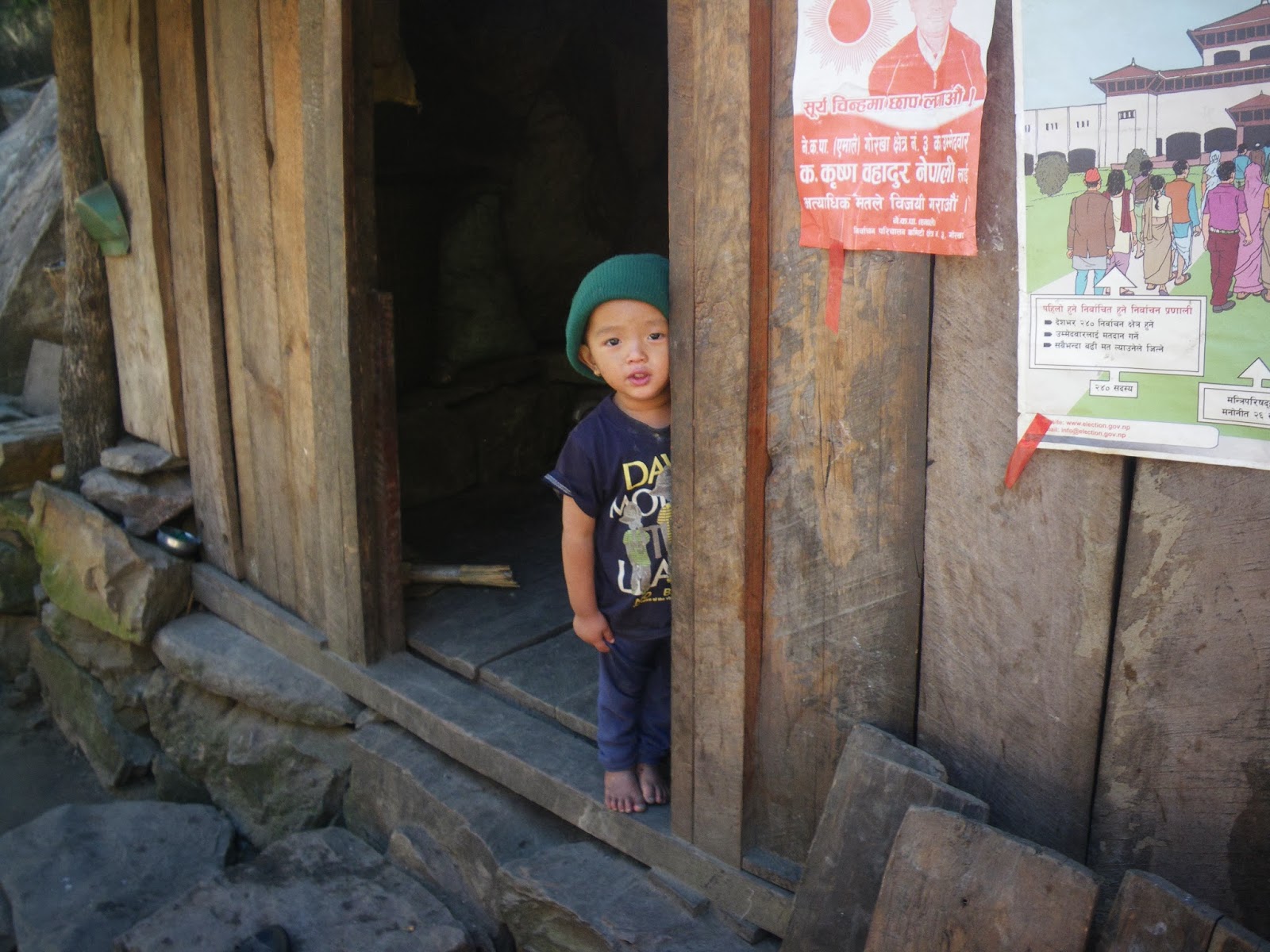
Manaslu Circuit: a 200 kilometer trek around Mount Manaslu, the world's eight highest mountain located in the Nepal Himalaya. The route takes one from hot, lowland villages to Larkya La, the dizzying high pass at 5,160 meters above sea level. 2011 was the first year that the entire circuit could be completed as a tea-house trek - meaning that one no longer is required to fuss with tents or arrange to carry food for the entire journey. I hiked the trail in the late 2013 season with my British friend Tony. Fortunately we received  excellent assistance from Buddhi, the mandatory Nepali guide and our extraordinary porter, Sahndip.


What a journey! As it turned out, November was a very fine time to trek around Manaslu. Aside from one apparent diffused bomb that I had no awareness of until miles down the road, we encountered no problems stemming from the electoral process. After the first day's drive from KTM to Arughat - from where we began the actual walking - I was informed that along the way, a bomb intended to terrorize the voting public from casting their votes was dismantled with no incident.

The daytime weather was often shorts and short-sleeves warm, while the evenings were always down jacket crisp and cold.

Along the way we encountered a few unfortunate souls who needed to turn back on account of altitude or microbe-induced illnesses. There were relatively few trekkers doing the Manaslu Circuit and after a few days of hiking, a pleasant sense of comraderie developed amongst our small intrepid community.

 While trying to remain mindfully present-focused, it was difficult not to anticipate the big challenge ahead - namely the crossing of the 5,160 metre high-altitude pass, the Larke La. There were  morale-sapping stories circulating of how the pass had been made impassible due to heavy snow fall and how the stone huts at Dharnashala were eventually overwhelmed with trekkers which in turn lead to food and fuel shortages and an eventual decision by the owner to shut the establishment down entirely. Our guide remained optimistic and shepherded us along. Indeed, the snow subsided and  the place opened up one day before we arrived! The 5 AM start in -17ยบ C was nevertheless  magical with one zillion stars lighting the way. The problems really only began on the way down. The topography on the descent was a treacherous massive skating rink. Everyone was sliding and falling, sometimes dangerously close to the edge. I had one especially harrowing brush with what could have been an "into the void" -type encounter. Bracing myself with my trekking pole, I said a spontaneous prayer of thanks upon hauling myself up.

The Himalayan views were mind-bendingly spectacular. The people we met in the villages were consistently warm, hospitable and gracious. Looking forward to a return visit.

Happy Trails Everyone.

Friday, November 15, 2013

Tridevi Temple

Kathmandu's Tridevi Temple amidst a jumble of wires, seems to capture the city's tussle between tradition and a quest for modernity.

Thursday, November 14, 2013

Kathmandu - 15 Years Later

Following a 22 hour journey from Vancouver via Guangzhou, I arrived in Kathmandu late in the evening. Last time I was here, Nepal proudly proclaimed to the world that it was a Himalayan Kingdom. Since then the royal family was elected out - and then killed, under strange circumstances, by the crown prince. As I rode in from the airport, the taxi driver pointed to the Royal Palace and mentioned casually that it was a museum.

Elections are approaching, and transportation-related enterprises are apparently on strike. Violence is brewing amidst the chaos of the Nepali electoral process. Reading the Kathmandu Post this morning, I see articles pertaining to violence in remote mountain villages, grenade attacks, and the possibility of a general strike. The shadow-side of Shangri La.

In addition, as we are getting set to begin a 200 kilometer trek in the remote Manaslu region, I read the following in the warm and pleasant Kathmandu coffee shop where a delicious cup of Himalayan java is unfogging my fuzzy, multiple time zone-induced consciousness: " With mercury plummeting and snowfall starting, thousands of people in the high altitude districts have started fleeing the cold and into the plains." Except a few of us. I picture a scene representative of Tintin and Snowy (Milou) in the Himalayas - Tintin Au Tibet.

Tuesday, November 5, 2013

Samoan Islands


While I have yet to post travel tales and photos of a recent trip to the Samoan Islands in the South Pacific, my home is already a chaotic scene of  winter gear to be used in a more challenging environment - an upcoming high altitude trek in Nepal - the Manaslu Circuit. Before I embrace my inner Tintin in Tibet, I will put my packing (and unpacking, and re-packing) aside for a while and convey some of my experiences as somewhat of a Johnny Come Lately Robinson Crusoe.

After having attended a psychology conference in Hawaii, I felt a little more adventure was in order, and so I caught a plane from Honolulu to  - and I love to say this town's name - Pago Pago, capital of American Samoa. From there I would later travel to the nearby independent republic of Samoa - what used to be called Western Samoa.


Over the years churches have succumbed to volcanic eruptions and tsunamis, but the spirit of the Samoan people has remained intact amidst natural disasters. Their joyous disposition was evident in all my encounters.

Robert Lewis Stevenson wrote, "In the South Seas" in 1908 in Samoa. Reading his accounts while visiting those very islands a hundred years later, gave me an appreciation of the massive changes effecting island life, but at the same time how significant aspects of this culture  thankfully remain unaltered. The Victorian photographs arranged with traditional local artifacts gives us a peek into Stevenson's home in Apia, Western Samoa.


Tuesday, October 22, 2013

A Softer Side of the City


  Nature has a lovely way of  unexpectedly softening our harsh urban landscape. 

 A web of platinum lace.

 A boundary-blurring misty path.

Thursday, September 26, 2013

Guess Who's Coming to Dinner? A War Criminal, That's Who!

"In his most recent tenure as Defense Minister, Ehud Barak has been on the front line facing issues around nuclear proliferation in Iran, Palestinian peace initiatives, and the Arab Spring.

The core of his effort as Prime Minister [of Israel] was devoted to the peace process. Significantly, Barak ordered the withdrawal of Israeli forces from South Lebanon. He led far-reaching efforts to negotiate peace agreements with Syria as well as the Palestinian authority, with the active participation of President Clinton and his administration."   

 
If one's only introduction to Ehud Barak was limited to the above  brief biographic sketch included in the Bon Mot Book Club's copy, it would perhaps be understandable why people would be interested in attending their upcoming gala  dinner-presentation at Vancouver's Four Season's Hotel.  http://allevents.in/vancouver/van-a-conversation-with-ehud-barak/582679258456531

Having interviewed the distraught mother grieving the death of her infant son, along with her little girl with chronic headache pain due to inoperable shrapnel lodged in her brain, I cannot remain silent in face of such a  hyperbolic, one-sided farcical description of a war criminal. Ehud Barak was Israel's Defense Minister when that country's military might  was unleashed on the encaged people of the Gaza Strip. "Encaged" because at the time of the slaughter of 1,400  Palestinians residing in Gaza, they were - as they continue to this day - prevented from enjoying the fundamental human right of freedom of movement. Over one and a half million people are confined into a 350 square kilometer space. The two-week bombardment of the Gaza Strip at the end of December 2008 and  beginning of January 2009 has been declared a war crime by the United Nations and the world's major human rights organizations.  Over-seeing this atrocity is hardly the action of a peacemaker.

The young documentary film maker who showed me around that ravaged urban landscape was forced to live with his family and eighteen others in a UN classroom during this so-called Operation Cast Lead. Thankfully they survived. Those taking refuge in another  school nearby were not as lucky; they perished when those classrooms were destroyed by Israeli fighter jets.

Ehud Barak, while Israel's Defense Minister, did nothing to stop the carnage of innocents. To present this individual as a peacemaker is to debase the concept of peace itself and to disregard those whose lives were either needlessly taken or else traumatized for ever.   

Vancouverites who stand for peace and social justice do not welcome war criminals into their city.


Tuesday, August 27, 2013

Vancouver Palestine Solidarity Transit Ad Campaign

Upon hearing that the Vancouver Transit  Palestine Solidarity Ad Campaign made its first appearance today, I went down to the Vancouver Centre Canada Line Station at Granville and Georgia Streets this afternoon to see how and where the "shrinking map of Palestine" poster was displayed.

It is downstairs where one boards the train. The location is very prominent and when I was there, many passengers were keenly observing it, discussing it amongst themselves, and photographing it with their mobile phones.

One individual who was standing next to me, asked me in a somewhat irritated voice, what I thought about this?

I saw this as either an invitation for a  potential confrontation or else as an opportunity to dialogue. I tell this story, as I think it is important for us to think through and strategize how to best interact with the ad and the people viewing it.

I told him it was a statement of fact and an important message which needs to be communicated. As such, I was pleased to see it.

He then launched into what might be construed as an attempt to deflect, invalidate and obfuscate. "There are so many other issues in the world, why do they always focus on Israel? What about Syria, Somalia, Iran?" 

At this point I realized it was important to minimize the likelihood of him escalating.

To do this, I  initially "joined" him by agreeing with the part of his message which was true. "You make an important and valid point". Immediately his disposition softened. Without skipping a beat, I then added: "You are right. Every injustice deserves a voice." He further relaxed his oppositional stance, and I could continue. "The existence of other atrocities and human rights violations in the world, however is no reason to remain silent in face of the systematic annihilation of Palestine". 

Bingo.

He was silent. Thought about the message. Looked up again at the maps. And walked away.

This is not to suggest that my answer is the only answer.  I was in fact caught off guard and not anticipating any conversation, as I too was busy taking a photo with my cell phone. There are many  reasons why this social justice campaign is needed. The Canadian government's complicity in the gradual dispossession of Palestine makes the issue immediately relevant to all Canadians who oppose racist, violent human rights abuses. 

The point I wish to share is that this little interaction alerted me to the fact that the message of the ad is indeed a powerful one that will surely elicit strong reactions in many viewers. It's good for us to make sure we maximize the impact by being prepared to shape the dialogue towards the social change message we want to convey.