Wednesday, December 20, 2023

The Saddest Christmas (2023) and Bleakest New Year's Eve (2024)


How to say, "Merry Christmas" while Gaza is being annihilated? How to say, "Happy New Year" when more than 22, 000 lives have been taken by Israel's barbaric genocide? Western media is parroting  absurd propaganda lies that Israel is defending itself against Hamas terrorists. Repeating this dishonest, racist formula only emboldens the vicious, indiscriminate bombing and ethnic cleansing. The horror is live-streamed onto our phones, yet even calling for a ceasfire is reframed as somehow being antisemitism. Since when is demanding an end to human rights violations and war crimes reflecting racism? 

70% of those slaughtered in Gaza are women and children. 

Are they all "terrorists", that nuclear weapons-enabled Israel needs to defend itself from? By non-stop massive, deadly bombing campaigns? Where starving people are huddled together in makeshift tents in "safe places" they were ordered to go to. Whose homes are demolished. Who are being deprived of food, water and medicine. These unfathomable mass atrocities have nothing to do with a "war on Hamas", but instead we are witnessing an  intensification of a seventy-five year-long campaign of ethnic cleansing of Palestinians by a settler colonial, Zionist project intent on replacing the indigenous  Palestinian population with a Jewish-only ethnonocracy. 

Israel has been violently oppressing Palestine for decades. In addition to militarily occupying Gaza for 56 years, Israel has cut-off Gaza from the rest of the world since 2006. It is an isolated, besieged territory. Claiming Israel  has a "right to defend itself" when beleaguered, encaged people resist their captors is simply nonsensical. A conqueror cannot claim self-defence when the oppressed people resist their subjugation. This is not a war between two armies. There is brutal, long-standing, illegal, military occupation confronting a people denied their fundamental freedoms who understandably refuse to be erased. 

Peace cannot come about by  a continuation of Israeli oppression and denial of basic freedoms. Lasting peace comes with justice. Justice means upholding international and humanitarian law, where all people are treated with dignity, freedom and equality.  From the River to the Sea.


In spite of the mind-numbing horror unfolding in Gaza and the West Bank, the good people of Vancouver did not succumb to despair, but instead creatively mobilized on New Year's Eve to express love, hope and solidarity with the Palestinian people as they continue to resist their oppressors and move ever closer to their liberation. It was a powerful, beautiful and meaningful New Year's Eve after all. 


Monday, December 11, 2023

Summertime in Hungary


My cousin and I were cycling around Hungary's Lake Balaton in 36 degree heat. Global climate change ensured that our outing was taking place during the absolute hottest month of July (2023) ever recorded - ever since even humans learned how to cycle! As I was visiting from Canada, and because we're both avid cyclists, we decided even though the entire European continent was enveloped in an infernal heatwave, that this was the day to set-out. 

Lake Balaton, Central Europe's largest, is a defining feature in the Hungarian landscape - both the natural, external, geographic landscape, and within, the interior, psychologic landscape. People literally love this body of water. One can frequently hear Hungarians talking about how while they may have swam elsewhere in the world, nothing compares to swimming in their precious Lake Balaton; sometimes referred to as the Hungarian Sea or the Hungarian Mediterranean. Beautiful indeed. 
   
Given the record-breaking heat, we decided to tackle the smaller 85 kilometre circuit (see the accompanying Strava route map) which included a short ferry ride. In addition to stunning sunflower fields, we were able to cool down en route at some  lovely, popular beaches. The wild cherry draught beer (naturally in moderate quantities) was also real nice. 
Next time, I hope to cycle the entire "Balatonkör" - the complete 204 km circuit of Lake Balaton. 


My summer in Hungary - Magyarország in Hungarian - turned out to be quite an active affair which included a week-long hiking trip through Nográd County in northern Hungary. At times we simply walked in and out of Slovakia through the ancient forest straddling the two countries.

I aim to weave a spiritual dimension into all my travels. Sometimes I actively plan this, while on other occasions the sacred unexpectedly reveals itself - allowing me a momentary, luminous glimpse into Heaven on Earth. As such, my heart quickened when I learned from our guide that we were walking in an area near Salgotarján where 18th century hermit caves had been carved out of the basalt. After climbing up the steep slopes and looking out at the expansive landscape from within this cave - for a moment, I understood that I was peering out into the infinite.


On another day of hiking, our small group visited a Buddhist temple.  Now, while I knew of the Hungarian pilgrim-scholar, Körösi Csoma Sándor (at times, he used the Anglicized, Alexander Csoma de Koros), I was astonished to visit an authentic Buddhist Temple in this rather remote region of Hungary in the small village of Tar. Here a Peace Stupa was constructed by the local Karma Kagyüpa Buddhist Community and later consecrated by His Holiness the Dalai Lama to honour the life of the itinerant Hungarian mystic, poet, seeker and linguist, Csoma Sándor. It was he who opened the eyes of the Western world to Buddhism by creating the first ever Tibetan-English dictionary whilst living in harsh, self-imposed isolated conditions in another remote hermitage  cave; this one in Zanskar, in the faraway, enchanted Indian Himalaya.  


Earlier this year I had  been trekking in the Nepal Himalaya and was familiar with Tibetan flags strung across high mountain passes. Seeing them here flutter in the hot Hungarian landscape surrounded by linden leaves and not along glaciated  high altitude peeks, I had a sense of the universality of, and indeed, the need for, their essential message of peace, unity and compassion for all sentient beings.

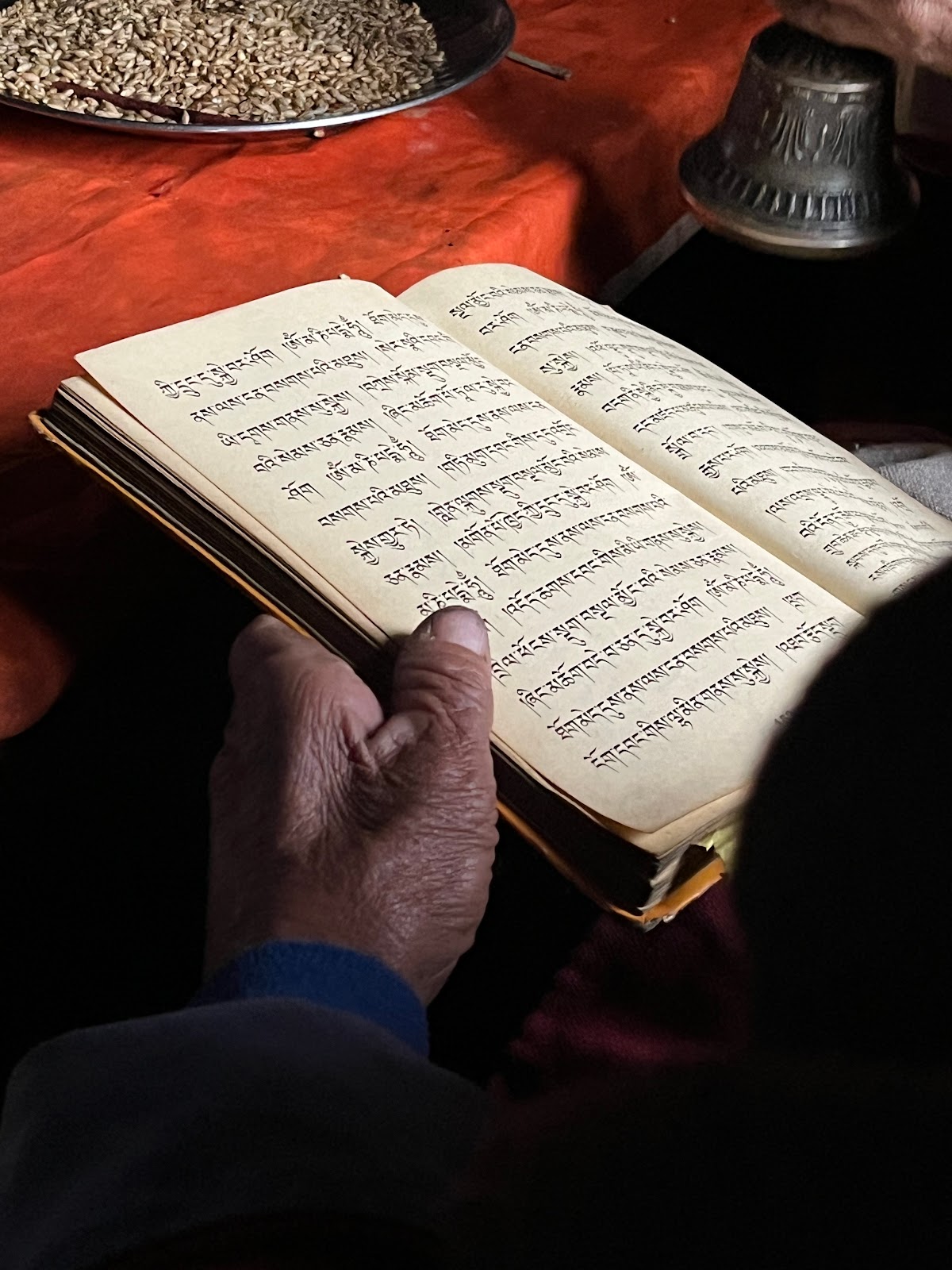
(The credit for the two photos from this Buddhist community do not belong to me. The stupa in the sunset is from the Group's website and the Tibetan prayer flags were photographed  by my cousin, Magda. In my astonishment to have stumbled upon this reverential place, I was so swept away that I remembered to take only one picture of a sacred text.)


Bús Zsófia was my father's grandmother. Little is known of her, except that she was born on April 14, 1874 and passed away on August 8, 1922. She was born in  Várpalota, the same Hungarian village where my dad was born and where this summer I was visiting with my few remaining relatives. She is my great grandmother. I gathered this limited, preliminary information by talking with archivists and searching birth and death certificates at City Hall. 

One afternoon, whilst hiking in the ancient oak forest with my cousin, she told me that another relative (everyone I meet seems somehow to be "a relative" in this town) recalled stories of how Zsófia was buried in the nearby, abandoned old cemetery. As a little girl she would occasionally visit Zsófia's tomb and was therefore able to describe for us the location of her gravestone. 

We found the overgrown tombstone and began clearing it up. What a totally unexpected, meaningful and powerful encounter it was for me to discover the place where my great grandmother had been resting for over a hundred years. And so the journey goes on  ...


Sunday, May 21, 2023

A Birthday in Nepal. Or: What's another year, when you're walking amidst a 45 million year-old mountain range?


Since my first journey to Nepal in 1989, I have been drawn back to what was  then the Hindu Kingdom of Nepal, and after painful political upheaval, now the Federal Democratic Republic of Nepal - at least a half dozen times. The charming and remote Himalayan villages, the cacophony of Thamel in Kathmandu, the unabashed display of spirituality, including a seamless interweave of Buddhism and Hinduism, the children greeting you with choruses of Namastes - each one a prayer recognizing our inherent divinity - the magic of this land continues to warmly embrace me.

As I live in Vancouver, I reside at sea level. Consequently, even though I am familiar with the signs of AMS - acute mountain sickness - I always experience  some pre-departure anxiety around this topic. I obsessively review the altitude at which symptoms are to first appear (2,500 meters above sea level is the usual threshold) and check whether my Diamox tablets have expired or not - which I take with me like some sort of pharmacologic rabbit's foot, as I haven't had to use them in years. This is all part of my pre-trip ritual, like packing and unpacking a thousand times in an attempt to shave off a gram or two in my luggage. 

Arriving in Kathmandu after a far too long flight always thrills me. The city has of course grown over the years. Some of the changes are positive. The redevelopment after the catastrophic 2015 earthquake is impressive. The artful reconstruction of ancient temples flattened by that horrific disaster is a joy to behold. The increased traffic congestion and accompanying pollution is obviously far less pleasant.  Here I confront one of many inescapable challenges and paradoxes facing the contemporary traveller to Nepal.  While many longtime Western adventurers to Nepal bemoan the gradual urbanization of  the country, complaining for example that development of roadways detracts from the traditional  tranquility of some  trekking routes, I find it selfish, disrespectful and smacking of a type of  "tourist colonialism". Why in the world should children residing in remote mountain villages have to continue to walk for half a day to go to school so one can have an "authentic trekking experience"? 


The challenge is not to purposefully bypass modernity, but to ensure that the precious and unique culture, aesthetic and history of Nepal is preserved while not erasing and replacing it with a quick, uninspired  project that lacks soul and integrity.


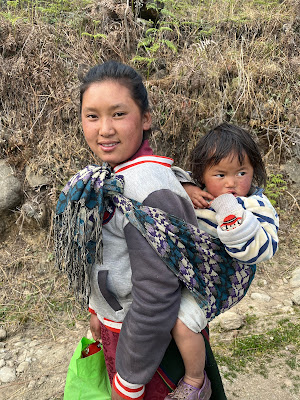
The itinerary this time was the Tamang Heritage and Langtang Valley Trek. The combining of these two separate trekking routes makes for a wonderful two week excursion. Tamang is next to the Langtang Valley. Tamang is a Tibetan Buddhist region. Walking amidst traditional villages is a richly rewarding experience. As in other parts of Nepal that I have visited, the Tamang people are very hospitable, gracious and kind. The views of the Langtang and Ganesh mountain ranges are spectacular. 


The Langtang Valley was heavily impacted by the enormous 2015 earthquake. The village of Langtang was entirely obliterated for example. Hundreds of lives were lost amidst the disaster. Over the ensuing years, villages have been beautifully reconstructed and the return of trekkers has provided income useful to further the reconstruction. Walking amidst the  mind-bendingly beautiful landscape and chatting with friendly villagers, I couldn't help but wonder how much of the psychological trauma  continued to reverberate in the people's consciousness. I hope that our return to their valley helped in some small way to soften that pain. 


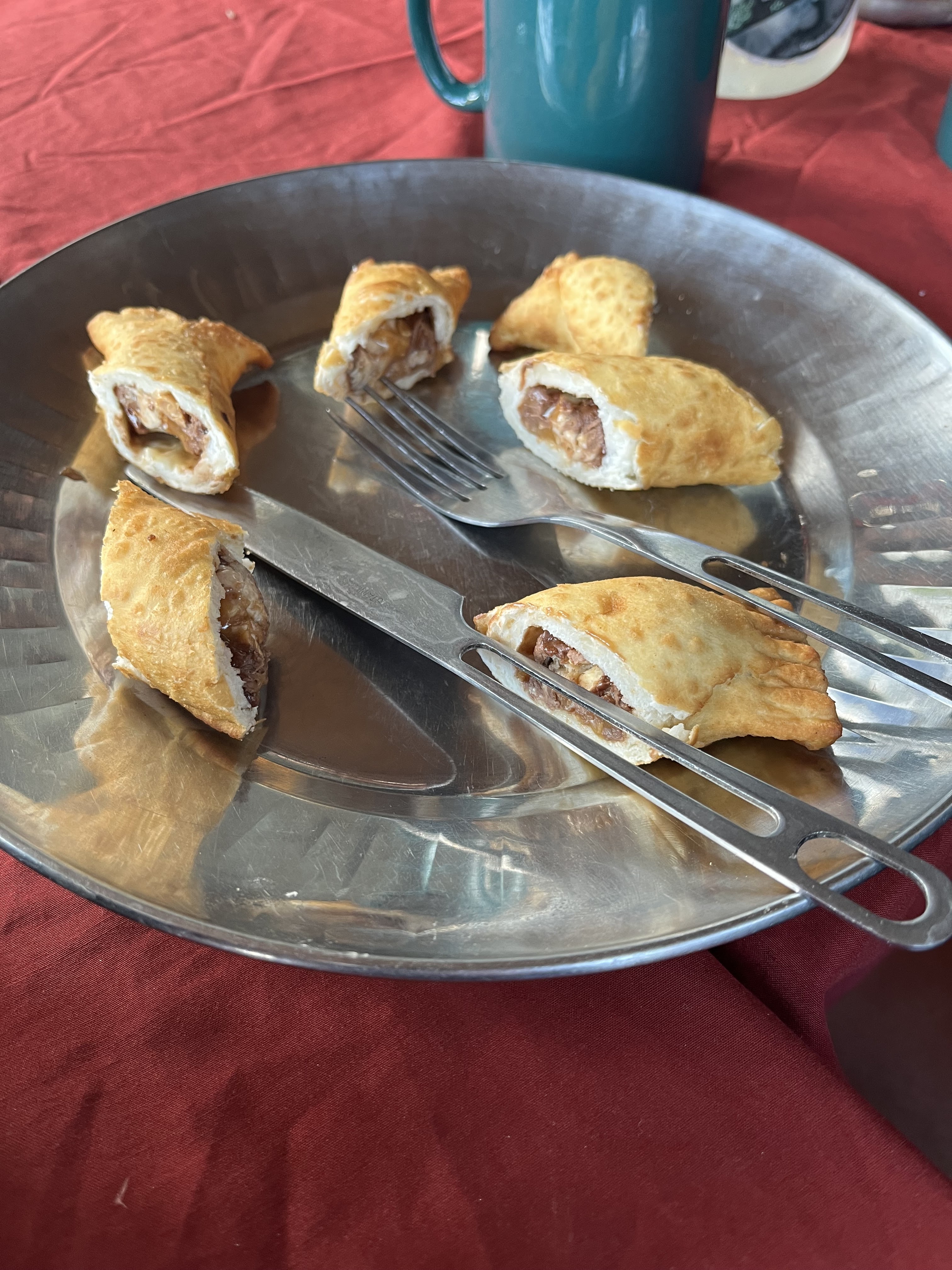
On a much lighter tone - the Snickers momos were an amazingly delicious and creative way to recharge after a demanding day of trekking.


One of the most memorable experiences was to spend my birthday in the Tamang village of Thuman. Participating in devotional chanting (and occasionally sipping yak butter tea and later chang - fermented barley wine) at one of the ancient Buddhist monasteries was an unexpectedly blessed and enormously meaningful birthday gift. Suddenly my notion that all travel is a pilgrimage was again crystallized. 


I felt an unmistakable sense of  connectedness to all which was present; there in that welcoming sacred space - and beyond. 


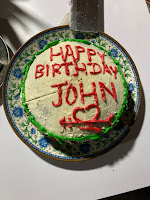
As I didn't wish to draw attention to myself, I refrained from mentioning my upcoming birthday to my travel companions. Nevertheless, our guide gleaned this information from our passports and later that evening, in the small, family-run guesthouse, our small group of intrepid travellers secretly arranged a surprise birthday party for me. A wonderful and happy culmination of my birthday in Nepal.


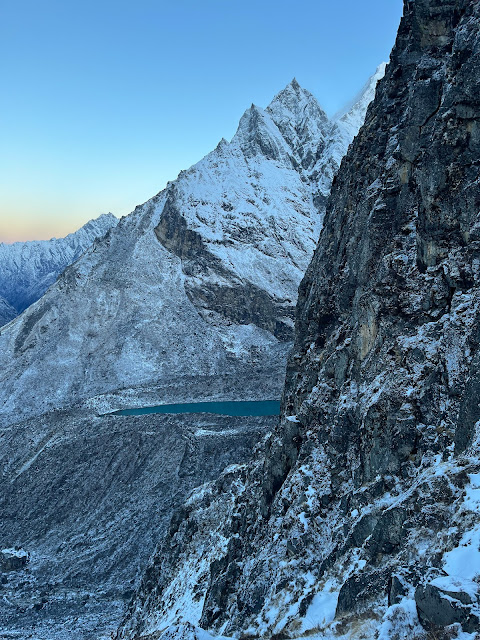
The village of Kyanjin Gompa was the final destination of the Langtang Valley Trek.  I did not sleep much the night prior to that last day. Anticipating the early morning 4:30 departure in total darkness to greet the rising sun at Kyanjin Ri  (Nepali for "peak"; elevation 4,400 meters and a 600 meter ascent) made for a fitful night.  The effort was of course well worth it. The view was spectacular. Our supportive banter motivated one another over the rougher patches and the camaraderie deepened with each breathless, slow step.


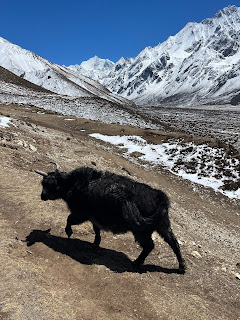
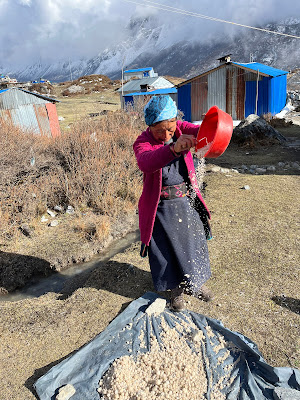
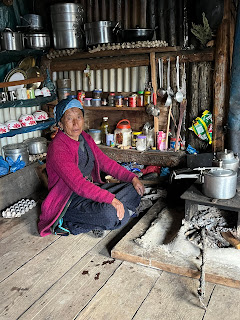
Back in the village later that afternoon, I notice a lady working at - well I'm not quite sure what she is doing. She continually empties basins filled with crystals while white particles flutter away. A beautiful and enigmatic image. I am curious and smile. She returns the smile and thus I approach her. Before I know it, I join her in her task. Two hours working together ensue and we have cleared all the sacks of salt crystals from the tiny pieces of material that have gotten loose from the bags containing the salt. The bags of salt were transported by donkeys to Kyanjin Gompa village to be used to supplement the diet of local, domesticated yaks. The technique was to empty the sacks of salt crystals into the basin which then are poured out to the ground. As the large, heavy salt crystals fall onto a tarp, the wind carries away the lighter fabric that had broken off from the sacks during the transport by donkey caravan. 


After completing the job, she thanked me for my assistance with a lovely smile while gently caressing my cheek. Beckoning me to her very simple home nearby, she gave me four small roasted potatoes. A precious, serendipitous encounter winds down. Another  unexpected gift from Nepal that will stay with me long after I leave.


Returning to the Kathmnadu Valley, I take a few more photographs before I start my long journey home. The magic of Nepal will likely draw me back into her embrace. Hope it'll be soon.

Namaste.


Friday, September 23, 2022

My letter to the leader of the federal New Democratic Party of Canada

Dear Mr. Jagmeet Singh, MP,                   September 23, 2022

This is Dr. John Soos, a Vancouver-based clinical psychologist. I have a long-standing personal and professional interest in Palestine - as a human rights advocate and as a psychologist who has been to the West Bank and Gaza on numerous occasions. I have personally seen the devastating impacts of the ongoing grave human rights abuses, including violent, state-sponsored military actions such as night-time raids and abduction of children in the West Bank, and indiscriminate, deadly aerial bombardments in Gaza. In addition to witnessing such atrocities, I have conducted training seminars for my Palestinian mental health colleagues on the treatment of psychological trauma stemming from decades of oppression, military occupation and siege. The reality on the ground is truly heart-breaking. 

Orchestrated Israeli propaganda campaigns are designed to obfuscate this harsh reality and indeed invert reality by claiming that Israel is the victim when in fact invading Israeli troops are violently subjugating the indigenous Palestinian population on a regular basis. All of us who have criticized Israeli policies have had to endure bad-faith, false accusations of antisemitism and I am certain as a result of your principled, courageous statements, you too will be vilified. Please remain steadfast and do not allow yourselves to be manipulated. 

I am just sharing this bit of context to underline the importance of recent NDP policy proposals on Palestine-Israel. They are a welcome development, and I applaud your integrity and compassion completely. I want to therefore thank you for taking this important approach and ask that you stay firm in your commitment to international law, human rights and common decency that have always characterized New Democratic values. 

Specifically, I’m pleased to see that the NDP is calling for increased pressure on the Israeli government to stop its plans to annex Palestinian territory. This is urgently needed considering the rapid expansion of Israel’s settlements on the ground. As you know, land theft and population transfer - in the form of Jewish-only segregated settlements are war crimes and hideous, unacceptable reminders that Apartheid and colonialism is an ongoing reality in Palestine-Israel. 

I’m counting on the NDP to advocate for human rights and international law in Palestine-Israel in Parliament. Occupation, colonialism, and apartheid are crimes against humanity and dismantling injustice is the way to attain peace, health and happiness for all persons residing there.  

Sincerely yours, 

John G Soos, PhD

Vancouver, BC


Monday, August 22, 2022

Resuming International Travel

Because of global restrictions on travel stemming from the pandemic, I'm only now writing about my first international trip in two years. Ironically I write this under strict quarantine conditions imposed by the Canadian Government. I won't call this "solitary confinement" as I don't want in any way to trivialize deplorable conditions political prisoners are subjected to. Let's just say, "home alone" for ten days. Why? An app and algorithm selected me for a "random, mandatory" covid test to be done  24 hours from receiving an email message at the Toronto airport after shortly landing from Manchester. I'm fully vaccinated with the addition of boosters and have no symptoms.  In fact I just cycled 175 kms with ease. More on that later.  But as I'm a big fan of public health and I just came back from the UK where there is near-zero remaining covid consciousness amidst the highly infectious Omicron strain, I  adhere with the request. The test came back positive - perhaps picking up noninfectious antigen remnants from an earlier covid exposure - but I comply fully. Here we go ...

Big Ride for Palestine

The Big Ride for Palestine was set up in 2015 by Palestine solidarity activists wanting to combine their love of cycling with an aim to raise awareness about Israel's brutal, ongoing military occupation and to raise funds for charities working in Palestine. I joined this year's Big Ride.  Money we raised goes to the Middle East Children's Alliance (MECA) specializing in assisting children traumatized by living under occupation, and The Gaza Sunbirds - a cycling club championing para-cyclists aiming to send a team to the 2024 Olympics in France. 

Getting set to head-out from Derby, UK

I cycled about 175 kms with 300 fellow cyclists - all committed to ending human rights violations in Palestine. We cycled from Derby to Stoke on July 29, Stoke to Manchester on July 30, and around the City of Manchester, July 31. Please visit their website for a deeper dive: 

https://www.thebigride4palestine.com/big-ride-summer-2022

Entering Manchester 

The overall experience was extraordinary. Coming from Canada, I was struck by the wide-spread community understanding of the need to end Israel's ongoing political violence in Palestine. The enthusiastic, heartfelt supportive greetings we received as we cycled through towns in  England was extraordinary. Sadly such impassioned embrace of human rights for Palestine is  much less evident in this country. Canada speaks of its commitment to international law and human rights, but the hypocrisy and exceptionalism with regards to Israel is glaring. 

As a cyclist who has been to Gaza on various occasions, including to conduct a seminar for mental health professionals on coping with their own psychological trauma, I chose to cycle in support of the Palestinian para-cycling team - The Gaza Sunbirds. 

Please check out my page, "Soos Cycles for Palestine" here: https://www.justgiving.com/fundraising/sooscyclesforpalestine

If you can and wish to donate, any amount is greatly appreciated.


Friday, May 1, 2020

Colombia!


My last trip before the world unexpectedly withdrew her welcoming arms and shut down its borders in face of the menacing, global pandemic was thankfully to Colombia. And what an extraordinary nation she is! Think of Colombia and you may imagine a dangerous country fighting a longstanding civil war, pitting left-wing guerrillas against right-wing paramilitary groups. Or you might think of violent cocaine cartels battling it out with government troops in the cities and jungles. In fact, Colombia is emerging from its dark past and shining forth in new-found hope and confidence. While the country had just recently in 2017 signed a peace deal with the guerrilla group, FARC - safe, colourful, vibrant city streets are now filled with warm, welcoming people who are more then ready to turn the page from a danger-filled past and embrace a joyous celebration of renewed optimism.  Beautifully restored Spanish colonial cities, resurgence of Indigenous culture, lush jungles, stunning beaches, mountains, museums, art galleries, street festivals, a cool urban vibe, and of course the world's finest coffee - Colombia has awakened with love and passion!


Cartagena. Or to be precise - Cartagena de Indias was my first encounter with Colombia. It has to be one of Latin America's most beautiful cities. The architectural grandeur of the walled, Centro Histórico is unforgettable. Plain to see why the entire Old Town is a UNESCO World Heritage site.


Castillo de San Felipe de Brajas is considered the greatest fortress built by Spain in any of their colonies. Peering over the massive ramparts, I enjoyed the contrasting view of the modern city in the near distance.


The street art, especially in Getsemani - the funkier side of Cartagena - is exciting, varied and  impressive. We can see works protesting against gentrification of the artists' working class neighbourhood to murals celebrating the Nobel Prize winning Colombian writer, Gabriel García Márquez.        


Long after returning home, I am still reading his magical realism masterpiece, "One Hundred Years of Solitude". Given our ongoing, world-wide self-isolation to mitigate the spread of the coronavirus, my pre-departure choice in reading was prescient. No doubt, I will follow this up with Gabo's (as he is affectionately known in his home-country), equally appropriate, "Love in the Time of Cholera".


From Cartagena my route took me to the Guachaca region where Parque Nacional Natural Tayrona is located. As luck would have it, the park was closed to help promote environmental regeneration. Occasionally the traveler can find unexpected magic amidst such disappointments. In this case, serendipity proffered an extraordinary gift in place of Tayrona. The opportunity to meet with Indigenous people in the village of Perico Aguao in the foothills of the Sierra Nevada de Santa Marta, where the mountains meet the Caribbean Sea, and later hike in their sacred jungle will forever remain with me. I continue to wear the bracelet given to me by the shaman - as a souvenir of, but more importantly - as a treasured talisman to help ward off the coronavirus.


Barichara - literally, "place of relaxation" is - well, just that. This remarkably well-preserved colonial town with cobblestone streets, peaceful old churches, gorgeous, neon pink bougainvilleas flowing over golden sandstone houses is a delight. Shanti - the  funky, delicious vegetarian restaurant was my daily hangout. It reflects perfectly the artsy, counter-culture vibe that has added an extra lovely touch to the local ambience. Not to be missed is the 10 km hike out of town along the Camino Real to the tiny village of Guane. Charming cartoon-like colourful buses provide welcome transport back to Barichara's central plaza.

                                                                                      
Local unusual gastronomic treat? Pan-fried hormigas culonas. Otherwise known as, fat-bottomed ants! Yes, that's right - not only did I attend a cooking class - after all, she turned out to be a fellow psychologist - I ate some! We spoke of how the eating of ants can be seen as a way (for me) to break out of restrictive conceptual barriers. Anything to delay the inevitable! They came out of the freezer, which made the process somehow less intimidating. Heads and legs needed to be removed before being lightly fried in water with freshly squeezed lemon juice for a few moments. I told myself it was a vegetarian meal - sort of - and that delving deeply into local life is one measure of authentic travel. And in this day of world-wide diminishing resources - they are, after all, a tasty alternate source of protein.


Bogotá. The capital city is  - among many things - cold. The contrast is especially jarring if coming from the warm Caribbean or hot jungles. Situated at 2,640 meters above sea level, besides cool temperatures, you may also experience symptoms of soroche - altitude sickness.  It is a large, sprawling, vibrant city of some 7.4 million people, representing a wide socio-economic spread. The impoverished hillside barrio of Egipto is a ten minute walk from the elegant campus of a private university.    

Catching a ride in a taxi with a miniature cathedral on the front dash immediately removed any big city jitters I may have had upon arrival.


Egipto was once one of Bogotá's most violent neighbourhoods. Today, former gang members will take you on a fascinating tour of their gritty streets - still controlled by gangs and otherwise a no-go zone. Breaking Borders was started by Universidad Externado de Colombia and Impulse Travel to provide a new, gun and drug-free life for the inhabitants. I felt uneasy at the start of our walking tour. The peek into this often overlooked segment of the city turned out, however to be informative, meaningful and indeed very enjoyable.


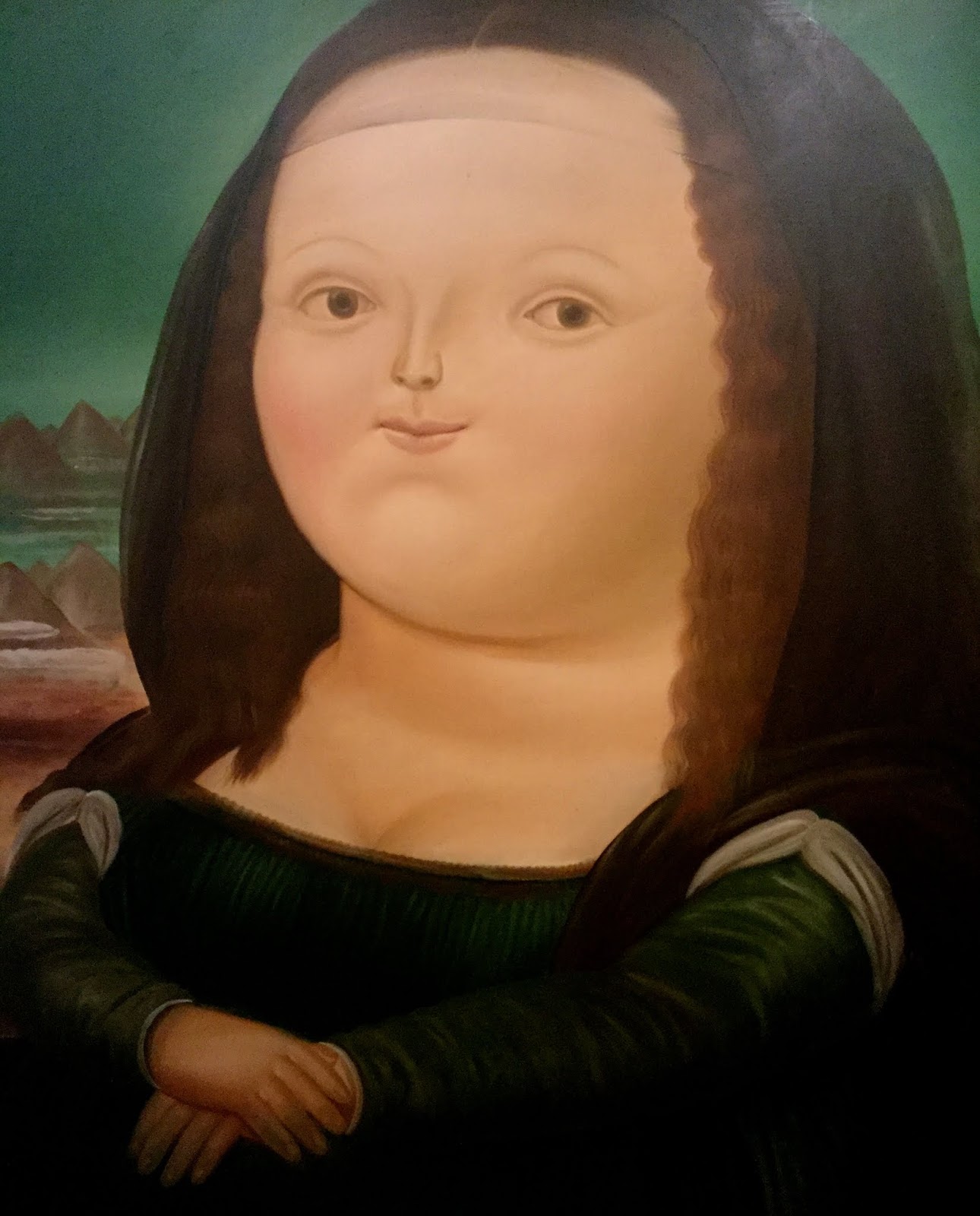
Big. Exaggerated. Satirical. Whimsically fat. Colombia's most famous artist is Fernando Botero. Plaza de Bolivar in central Bogotá is where Museo Botero is located. His chubby, irreverent version of  Mona Lisa was among my favourite pieces.


Stunning pre-Hispanic, Indigenous creativity is beautifully displayed in the nearby Museo del Oro (Gold Museum). The exquisite detail of these masterpieces is breathtaking. While admiring these marvellous early works, my wonderment later switched to rage at the conquistadors  - who plundered the golden art while deepening the colonial subjugation and exploitation of Colombia's First People.


I ended my trip to Colombia in a cathedral. As a Catholic country, there are places of worship everywhere. Some churches are grand, ornate structures, whereas others are simple rural chapels. I often took time to slow my pace,  get away from crowds or the heat, and say a quiet prayer in sanctuaries throughout my journey. To spend contemplative time in places where countless devout people over the years - sometimes centuries - have been drawn to before me, always comforts and lifts my soul. The Salt Cathedral was unlike anything I had ever seen before. It is an underground, ethereal cathedral carved out of salt in the town of Zipaquirá - about fifty kilometers from Bogotá and easily accessed by local bus. 
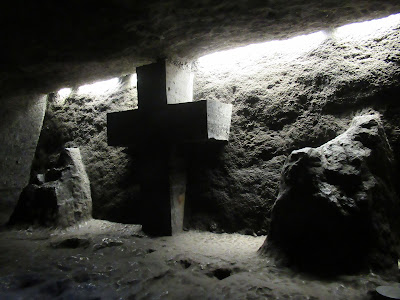


In this dark, mysterious, cavernous place, I gave thanks to be able to spend time in Colombia, and promised myself that I will one day return to deepen my acquaintanceship with her.

In the meanwhile,  while the coronavirus pandemic continues to restrict further travel, I will read Colombian writer, Gabriel Garcia Márquez', other fittingly titled novel - "Love in the Time of Cholera".